Halloween in the City Weekender Returns: Saturday 24 October
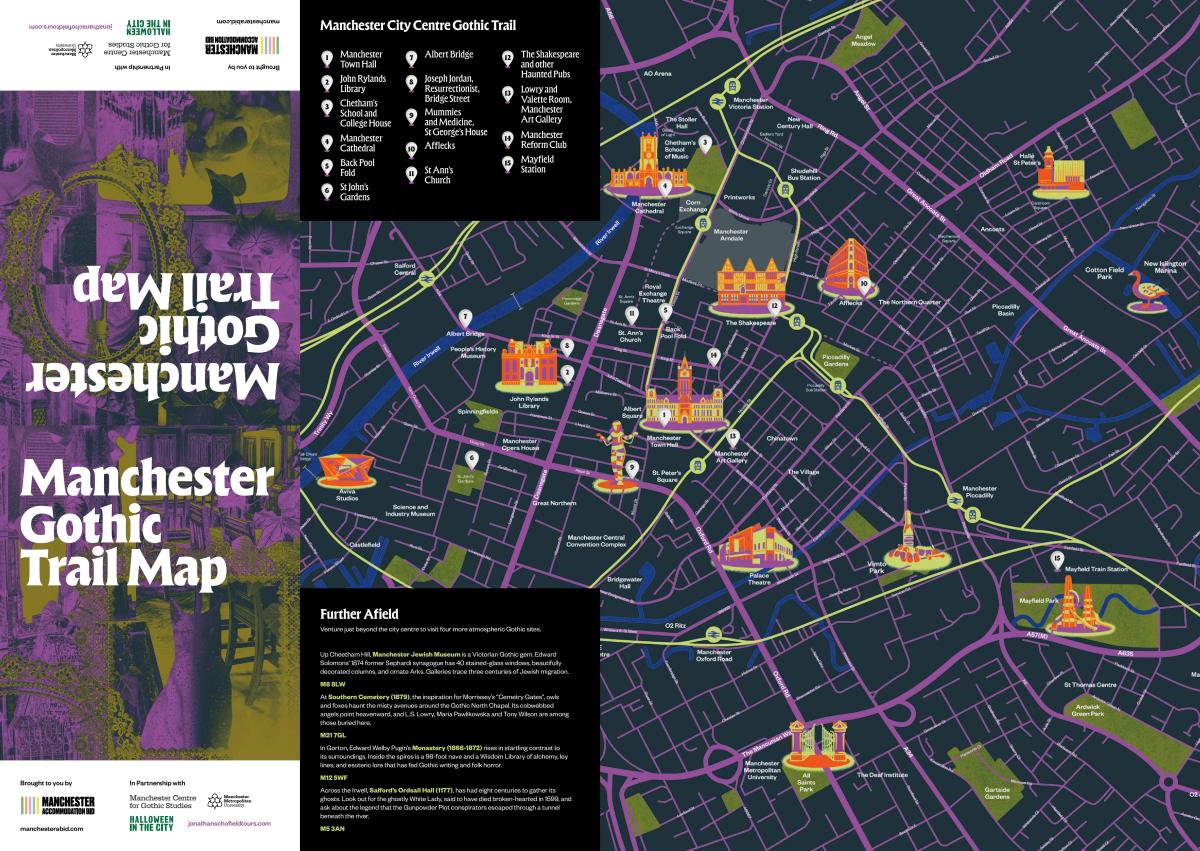
Manchester Gothic Trail
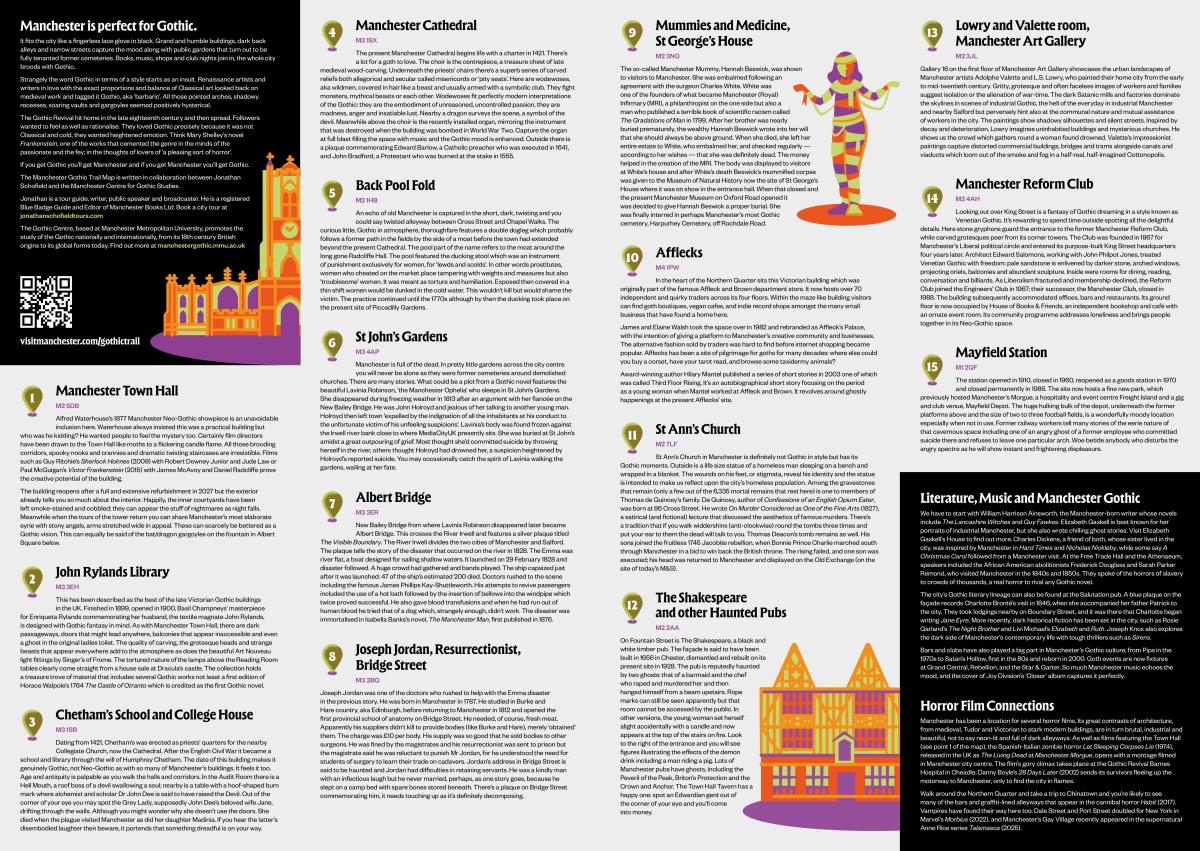
It fits the city like a fingerless lace glove in black. Grand and humble buildings, dark back alleys and narrow streets capture the mood along with public gardens that turn out to be fully tenanted former cemeteries. Books, music, shops and club nights join in, the whole city broods with Gothic.
Strangely the word Gothic in terms of a style starts as an insult. Renaissance artists and writers in love with the exact proportions and balance of Classical art looked back on medieval work and tagged it Gothic, aka ‘barbaric’. All those pointed arches, shadowy recesses, soaring vaults and gargoyles seemed positively hysterical.
The Gothic Revival hit home in the late eighteenth century and then spread. Followers wanted to feel as well as rationalise. They loved Gothic precisely because it was not Classical and cold, they wanted heightened emotion. Think Mary Shelley’s novel Frankenstein, one of the works that cemented the genre in the minds of the passionate and the fey; in the thoughts of lovers of ‘a pleasing sort of horror’.
If you get Gothic you’ll get Manchester and if you get Manchester you’ll get Gothic.
The Manchester Gothic Trail Map is written in collaboration between Jonathan Schofield and the Manchester Centre for Gothic Studies.
Jonathan is a tour guide, writer, public speaker and broadcaster. He is a registered Blue Badge Guide and Editor of Manchester Books Ltd. Book a city tour at jonathanschofieldtours.com
The Gothic Centre, based at Manchester Metropolitan University, promotes the study of the Gothic nationally and internationally, from its 18th century British origins to its global forms today. Find out more at manchestergothic.mmu.ac.uk
Alfred Waterhouse’s 1877 Manchester Neo-Gothic showpiece is an unavoidable inclusion here. Waterhouse always insisted this was a practical building but who was he kidding? He wanted people to feel the mystery too. Certainly film directors have been drawn to the Town Hall like moths to a flickering candle flame. All those brooding corridors, spooky nooks and crannies and dramatic twisting staircases are irresistible. Films such as Guy Ritchie’s Sherlock Holmes (2009) with Robert Downey Junior and Jude Law or Paul McGuigan’s Victor Frankenstein (2015) with James McAvoy and Daniel Radcliffe prove the creative potential of the building.
The building reopens after a full and extensive refurbishment in 2027 but the exterior already tells you so much about the interior. Happily, the inner courtyards have been left smoke-stained and cobbled; they can appear the stuff of nightmares as night falls. Meanwhile when the tours of the tower return you can share Manchester’s most elaborate eyrie with stony angels, arms stretched wide in appeal. These can scarcely be bettered as a Gothic vision. This can equally be said of the bat/dragon gargoyles on the fountain in Albert Square below.
This has been described as the best of the late Victorian Gothic buildings in the UK. Finished in 1899, opened in 1900, Basil Champneys’ masterpiece for Enriqueta Rylands commemorating her husband, the textile magnate John Rylands, is designed with Gothic fantasy in mind. As with Manchester Town Hall, there are dark passageways, doors that might lead anywhere, balconies that appear inaccessible and even a ghost in the original ladies toilet. The quality of carving, the grotesque heads and strange beasts that appear everywhere add to the atmosphere as does the beautiful Art Nouveau light fittings by Singer’s of Frome. The tortured nature of the lamps above the Reading Room tables clearly come straight from a house sale at Dracula’s castle. The collection holds a treasure trove of material that includes several Gothic works not least a first edition of Horace Walpole’s 1764 The Castle of Otranto which is credited as the first Gothic novel.
Dating from 1421, Chetham’s was erected as priests’ quarters for the nearby Collegiate Church, now the Cathedral. After the English Civil War it became a school and library through the will of Humphrey Chetham. The date of this building makes it genuinely Gothic, not Neo-Gothic as with so many of Manchester’s buildings. It feels it too. Age and antiquity is palpable as you walk the halls and corridors. In the Audit Room there is a Hell Mouth, a roof boss of a devil swallowing a soul; nearby is a table with a hoof-shaped burn mark where alchemist and scholar Dr John Dee is said to have raised the Devil. Out of the corner of your eye you may spot the Grey Lady, supposedly John Dee’s beloved wife Jane, drifting through the walls. Although you might wonder why she doesn’t use the doors. She died when the plague visited Manchester as did her daughter Madinia. If you hear the latter’s disembodied laughter then beware, it portends that something dreadful is on your way.
The present Manchester Cathedral begins life with a charter in 1421. There’s a lot for a goth to love. The choir is the centrepiece, a treasure chest of late medieval wood-carving. Underneath the priests’ chairs there’s a superb series of carved reliefs both allegorical and secular called misericords or ‘pity seats’. Here are wodewoses, aka wildmen, covered in hair like a beast and usually armed with a symbolic club. They fight monsters, mythical beasts or each other. Wodewoses fit perfectly modern interpretations of the Gothic: they are the embodiment of unreasoned, uncontrolled passion, they are madness, anger and insatiable lust. Nearby a dragon surveys the scene, a symbol of the devil. Meanwhile above the choir is the recently installed organ, mirroring the instrument that was destroyed when the building was bombed in World War Two. Capture the organ at full blast filling the space with music and the Gothic mood is enhanced. Outside there is a plaque commemorating Edward Barlow, a Catholic preacher who was executed in 1641, and John Bradford, a Protestant who was burned at the stake in 1555.
An echo of old Manchester is captured in the short, dark, twisting and you could say twisted alleyway between Cross Street and Chapel Walks. The curious little, Gothic in atmosphere, thoroughfare features a double dogleg which probably follows a former path in the fields by the side of a moat before the town had extended beyond the present Cathedral. The pool part of the name refers to the moat around the long gone Radcliffe Hall. The pool featured the ducking stool which was an instrument of punishment exclusively for women, for ‘lewds and scolds’. In other words prostitutes, women who cheated on the market place tampering with weights and measures but also ‘troublesome’ women. It was meant as torture and humiliation. Exposed then covered in a thin shift women would be dunked in the cold water. This wouldn’t kill but would shame the victim. The practice continued until the 1770s although by then the ducking took place on the present site of Piccadilly Gardens.
Manchester is full of the dead. In pretty little gardens across the city centre you will never be alone as they were former cemeteries around demolished churches. There are many stories. What could be a plot from a Gothic novel features the beautiful Lavinia Robinson, ‘the Manchester Ophelia’ who sleeps in St John’s Gardens. She disappeared during freezing weather in 1813 after an argument with her fiancée on the New Bailey Bridge. He was John Holroyd and jealous of her talking to another young man. Holroyd then left town ‘expelled by the indignation of all the inhabitants at his conduct to the unfortunate victim of his unfeeling suspicions’. Lavinia’s body was found frozen against the Irwell river bank close to where MediaCityUK presently sits. She was buried at St John’s amidst a great outpouring of grief. Most thought she’d committed suicide by throwing herself in the river, others thought Holroyd had drowned her, a suspicion heightened by Holroyd’s reported suicide. You may occasionally catch the spirit of Lavinia walking the gardens, wailing at her fate.
New Bailey Bridge from where Lavinia Robinson disappeared later became Albert Bridge. This crosses the River Irwell and features a silver plaque titled The Visible Boundary. The River Irwell divides the two cities of Manchester and Salford. The plaque tells the story of the disaster that occurred on the river in 1828. The Emma was river flat, a boat designed for sailing shallow waters. It launched on 29 February 1828 and disaster followed. A huge crowd had gathered and bands played. The ship capsized just after it was launched: 47 of the ship’s estimated 200 died. Doctors rushed to the scene including the famous James Phillips Kay-Shuttleworth. His attempts to revive passengers included the use of a hot bath followed by the insertion of bellows into the windpipe which twice proved successful. He also gave blood transfusions and when he had run out of human blood he tried that of a dog which, strangely enough, didn’t work. The disaster was immortalised in Isabella Banks’s novel, The Manchester Man, first published in 1876.
Joseph Jordan was one of the doctors who rushed to help with the Emma disaster in the previous story. He was born in Manchester in 1787. He studied in Burke and Hare country, aka Edinburgh, before returning to Manchester in 1812 and opened the first provincial school of anatomy on Bridge Street. He needed, of course, fresh meat. Apparently his suppliers didn’t kill to provide bodies (like Burke and Hare), merely ‘obtained’ them. The charge was £10 per body. His supply was so good that he sold bodies to other surgeons. He was fined by the magistrates and his resurrectionist was sent to prison but the magistrate said he was reluctant to punish Mr Jordan, for he understood the need for students of surgery to learn their trade on cadavers. Jordan’s address in Bridge Street is said to be haunted and Jordan had difficulties in retaining servants. He was a kindly man with an infectious laugh but he never married, perhaps, as one story goes, because he slept on a camp bed with spare bones stored beneath. There’s a plaque on Bridge Street commemorating him, it needs touching up as it’s definitely decomposing.
The so-called Manchester Mummy, Hannah Beswick, was shown to visitors to Manchester. She was embalmed following an agreement with the surgeon Charles White. White was one of the founders of what became Manchester (Royal) Infirmary (MRI), a philanthropist on the one side but also a man who published a terrible book of scientific racism called The Gradations of Man in 1799. After her brother was nearly buried prematurely, the wealthy Hannah Beswick wrote into her will that she should always be above ground. When she died, she left her entire estate to White, who embalmed her, and checked regularly — according to her wishes — that she was definitely dead. The money helped in the creation of the MRI. The body was displayed to visitors at White’s house and after White’s death Beswick’s mummified corpse was given to the Museum of Natural History now the site of St George’s House where it was on show in the entrance hall. When that closed and the present Manchester Museum on Oxford Road opened it was decided to give Hannah Beswick a proper burial. She was finally interred in perhaps Manchester’s most Gothic cemetery, Harpurhey Cemetery, off Rochdale Road.
In the heart of the Northern Quarter sits this Victorian building which was originally part of the famous Affleck and Brown department store. It now hosts over 70 independent and quirky traders across its four floors. Within the maze like building visitors can find goth boutiques, vegan cafes, and indie record shops amongst the many small business that have found a home here.
James and Elaine Walsh took the space over in 1982 and rebranded as Affleck’s Palace, with the intention of giving a platform to Manchester’s creative community and businesses. The alternative fashion sold by traders was hard to find before internet shopping became popular. Afflecks has been a site of pilgrimage for goths for many decades: where else could you buy a corset, have your tarot read, and browse some taxidermy animals?
Award-winning author Hilary Mantel published a series of short stories in 2003 one of which was called Third Floor Rising. It’s an autobiographical short story focusing on the period as a young woman when Mantel worked at Affleck and Brown. It revolves around ghostly happenings at the present Afflecks’ site.
St Ann’s Church in Manchester is definitely not Gothic in style but has its Gothic moments. Outside is a life size statue of a homeless man sleeping on a bench and wrapped in a blanket. The wounds on his feet, or stigmata, reveal his identity and the statue is intended to make us reflect upon the city’s homeless population. Among the gravestones that remain (only a few out of the 6,335 mortal remains that rest here) is one to members of Thomas de Quincey’s family. De Quincey, author of Confessions of an English Opium Eater, was born at 86 Cross Street. He wrote On Murder Considered as One of the Fine Arts (1827), a satirical (and fictional) lecture that discussed the aesthetics of famous murders. There’s a tradition that if you walk widdershins (anti-clockwise) round the tombs three times and put your ear to them the dead will talk to you. Thomas Deacon’s tomb remains as well. His sons joined the fruitless 1745 Jacobite rebellion, when Bonnie Prince Charlie marched south through Manchester in a bid to win back the British throne. The rising failed, and one son was executed; his head was returned to Manchester and displayed on the Old Exchange (on the site of today’s M&S).
On Fountain Street is The Shakespeare, a black and white timber pub. The façade is said to have been built in 1656 in Chester, dismantled and rebuilt on its present site in 1928. The pub is reputedly haunted by two ghosts: that of a barmaid and the chef who raped and murdered her and then hanged himself from a beam upstairs. Rope marks can still be seen apparently but that room cannot be accessed by the public. In other versions, the young woman set herself alight accidentally with a candle and now appears at the top of the stairs on fire. Look to the right of the entrance and you will see figures illustrating the effects of the demon drink including a man riding a pig. Lots of Manchester pubs have ghosts, including the Peveril of the Peak, Briton’s Protection and the Crown and Anchor. The Town Hall Tavern has a happy one: spot an Edwardian gent out of the corner of your eye and you’ll come into money.
Gallery 16 on the first floor of Manchester Art Gallery showcases the urban landscapes of Manchester artists Adolphe Valette and L.S. Lowry, who painted their home city from the early to mid-twentieth century. Gritty, grotesque and often faceless images of workers and families suggest isolation or the alienation of war-time. The dark Satanic mills and factories dominate the skylines in scenes of industrial Gothic, the hell of the everyday in industrial Manchester and nearby Salford but perversely hint also at the communal nature and mutual assistance of workers in the city. The paintings show shadowy silhouettes and silent streets. Inspired by decay and deterioration, Lowry imagines uninhabited buildings and mysterious churches. He shows us the crowd which gathers round a woman found drowned. Valette’s impressionist paintings capture distorted commercial buildings, bridges and trams alongside canals and viaducts which loom out of the smoke and fog in a half-real, half-imagined Cottonopolis.
Looking out over King Street is a fantasy of Gothic dreaming in a style known as Venetian Gothic. It’s rewarding to spend time outside spotting all the delightful details. Here stone gryphons guard the entrance to the former Manchester Reform Club, while carved grotesques peer from its corner towers. The Club was founded in 1867 for Manchester’s Liberal political circle and entered its purpose-built King Street headquarters four years later. Architect Edward Salomons, working with John Philpot Jones, treated Venetian Gothic with freedom: pale sandstone is enlivened by darker stone, arched windows, projecting oriels, balconies and abundant sculpture. Inside were rooms for dining, reading, conversation and billiards. As Liberalism fractured and membership declined, the Reform Club joined the Engineers’ Club in 1967; their successor, the Manchester Club, closed in 1988. The building subsequently accommodated offices, bars and restaurants. Its ground floor is now occupied by House of Books & Friends, an independent bookshop and café with an ornate event room. Its community programme addresses loneliness and brings people together in its Neo-Gothic space.
The station opened in 1910, closed in 1960, reopened as a goods station in 1970 and closed permanently in 1986. The site now hosts a fine new park, which previously hosted Manchester’s Morgue, a hospitality and event centre Freight Island and a gig and club venue, Mayfield Depot. The huge hulking bulk of the depot, underneath the former platforms above and the size of two to three football fields, is a wonderfully moody location especially when not in use. Former railway workers tell many stories of the eerie nature of that cavernous space including one of an angry ghost of a former employee who committed suicide there and refuses to leave one particular arch. Woe betide anybody who disturbs the angry spectre as he will show instant and frightening displeasure.
Further Afield
Venture just beyond the city centre to visit four more atmospheric Gothic sites.
Manchester Jewish Museum
M8 8LW
Up Cheetham Hill, Manchester Jewish Museum is a Victorian Gothic gem. Edward Solomons’ 1874 former Sephardi synagogue has 40 stained-glass windows, beautifully decorated columns, and ornate Arks. Galleries trace three centuries of Jewish migration.
Southern Cemetery
M21 7GL
At Southern Cemetery (1879), the inspiration for Morrissey’s “Cemetry Gates”, owls and foxes haunt the misty avenues around the Gothic North Chapel. Its cobwebbed angels point heavenward, and L.S. Lowry, Maria Pawlikowska and Tony Wilson are among those buried here.
Monastery, Gorton
M12 5WF
In Gorton, Edward Welby Pugin’s Monastery (1866-1872) rises in startling contrast to its surroundings. Inside the spires is a 98-foot nave and a Wisdom Library of alchemy, ley lines, and esoteric lore that has fed Gothic writing and folk horror.
Salford’s Ordsall Hall
M5 3AN
Across the Irwell, Salford’s Ordsall Hall (1177), has had eight centuries to gather its ghosts. Look out for the ghostly White Lady, said to have died broken-hearted in 1599, and ask about the legend that the Gunpowder Plot conspirators escaped through a tunnel beneath the river.
Brought to you by
manchesterabid.com
Search for something...
Continue your Manchester story by exploring further.